
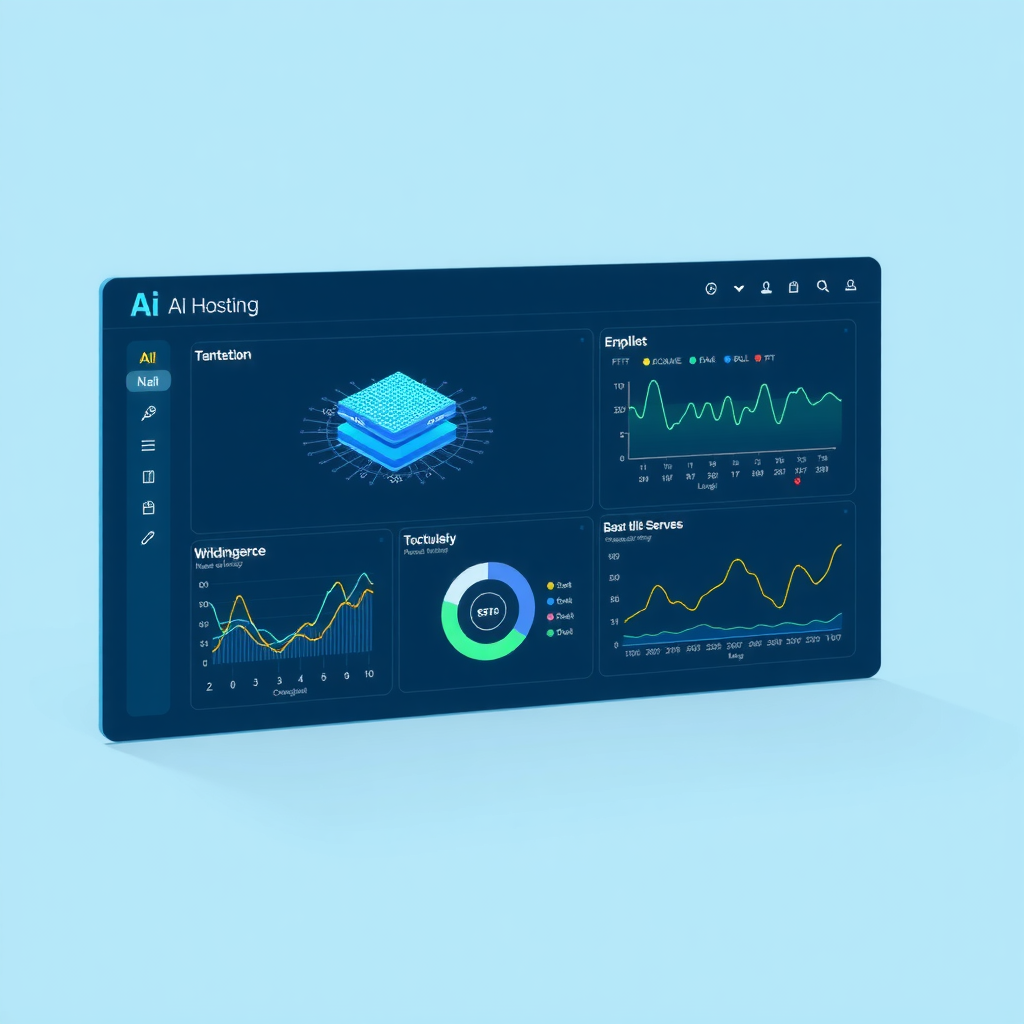
“`html
Beyond the Server: How AI-Powered Hosting Solutions Are Revolutionizing Web Performance
The days of static, one-size-fits-all web hosting are rapidly fading into the digital rearview mirror. As websites become more dynamic, traffic spikes more unpredictable, and cyber threats more sophisticated, traditional hosting models are struggling to keep pace. Enter the game-changer: **AI-powered hosting solutions**. This isn’t just a buzzword; it’s a fundamental shift in how servers operate, how security is enforced, and how performance is optimized. By leveraging machine learning algorithms, predictive analytics, and intelligent automation, AI hosting doesn’t just *react* to problems—it *anticipates* them. In this deep dive, we’ll explore how this technology is reshaping the landscape, what it means for your website’s speed and uptime, and why forward-thinking developers are already making the switch. Whether you’re running a high-traffic e-commerce store or a personal blog, understanding AI’s role in your hosting stack is no longer optional—it’s essential.
1. Predictive Resource Scaling: The End of the “Traffic Spike Panic”
One of the most tangible benefits of AI-powered hosting is its ability to perform **predictive autoscaling**. Traditional cloud hosting relies on reactive rules—if CPU usage hits 80%, spin up another instance. The problem? By the time that rule triggers, your site may have already slowed to a crawl, losing visitors and revenue. AI flips this model on its head. Instead of reacting to current load, machine learning models analyze historical traffic patterns, seasonal trends, and even external factors like marketing campaigns or news events to forecast demand hours—or even days—in advance.
Here’s how it works in practice: The AI engine ingests terabytes of server logs, Google Analytics data, and CDN metrics. It identifies recurring patterns (e.g., “every Black Friday, traffic to checkout pages increases 400%”) and creates a predictive model. When the model detects an imminent surge, it pre-emptively allocates additional RAM, CPU, and bandwidth. Conversely, during quiet periods, it scales *down* resources to save you money—all without a single manual intervention.
- Zero Downtime Deployments: AI can orchestrate containerized environments, shifting workloads between nodes before a failure occurs.
- Cost Efficiency: You only pay for resources that the AI *knows* you’ll need, not a buffer for worst-case scenarios.
- Real-Time Adaptation: If an unexpected viral post hits, the AI adjusts its model on the fly, learning from the anomaly.
For site owners, this means no more frantic 3 AM calls to support when a Reddit thread goes viral. The infrastructure simply expands seamlessly, and your visitors never experience a hiccup. This predictive capability is particularly crucial for SaaS platforms and media sites where latency directly correlates with bounce rate.
2. AI-Driven Security: Proactive Threat Hunting and Self-Healing Firewalls
Cybersecurity is an arms race, and traditional signature-based firewalls are losing. Hackers deploy polymorphic malware and zero-day exploits that slip past known threat databases. AI-powered hosting solutions employ **behavioral analysis** and **anomaly detection** to stop attacks that have never been seen before. Instead of asking “Is this a known virus?”, the AI asks, “Is this behavior normal for this user or bot?”
Consider a typical DDoS (Distributed Denial of Service) attack. A flood of requests comes from thousands of IPs. A legacy system might block IPs after a threshold, but clever attackers rotate IPs constantly. An AI system, however, examines the *patterns* of the requests—the timing, the headers, the mouse movement if it’s a browser challenge, even the typo latency. It builds a baseline of “normal” traffic for your specific site. When traffic deviates from this baseline (e.g., a sudden 10x increase in requests to a login page from geographically dispersed IPs), the AI triggers an automated response: it can rate-limit, challenge with CAPTCHAs, or even blackhole the offending traffic at the edge—all in milliseconds.
Moreover, AI enables **self-healing infrastructure**. If a compromised file is detected, the system doesn’t just quarantine it; it restores the original from a verified backup, patches the vulnerability that allowed the breach, and then runs a forensic analysis to ensure no lateral movement occurred. This reduces the mean time to resolution (MTTR) from days to minutes. For e-commerce sites handling credit card data, this proactive stance isn’t just a luxury—it’s a compliance requirement under PCI-DSS 4.0, which now mandates automated threat response mechanisms.
3. Intelligent Content Delivery and Code Optimization
Beyond infrastructure, AI is optimizing the very bytes that reach your users. Traditional CDNs (Content Delivery Networks) cache static assets like images and CSS on edge servers. But they don’t understand *context*. An AI-powered CDN, however, can make split-second decisions about what to cache, where to cache it, and how to compress it based on the user’s device, network connection, and even real-time global events.
For instance, if a user is on a 3G connection in a remote area, the AI might automatically serve a lower-resolution version of your hero image or use WebP instead of PNG, without requiring a separate “mobile” site. It can also predict which pages a user is likely to visit next (based on session history and site-wide navigation patterns) and pre-fetch those resources to the edge server closest to them. This technique, known as **predictive prefetching**, can cut perceived load times by up to 40%.
Furthermore, AI is now being used for **automatic code and database optimization**. The hosting platform can analyze your WordPress or Node.js application’s slow queries, identify missing indexes, and even suggest (or automatically apply) caching plugins or opcode optimizations. Some advanced platforms use reinforcement learning to experiment with different PHP worker configurations or database connection pools, learning which settings yield the fastest response times for your specific workload. This is a massive win for non-developers who lack the time to fine-tune `my.cnf` or `nginx.conf` files.
4. Intelligent Support and Self-Healing Diagnostics
Let’s face it: even with all this automation, you’ll still have questions. But AI is transforming customer support from a “ticket and wait” model to a “diagnose and fix” model. Modern AI-powered hosting solutions embed **intelligent virtual assistants** that don’t just regurgitate FAQ articles. They have access to your server’s telemetry, error logs, and configuration files. When you type “my site is slow,” the AI doesn’t ask for more details—it immediately runs a diagnostic script.
It checks server response times, database query logs, memory usage, and recent deployment changes. Within seconds, it might respond: “I’ve detected a memory leak in your WooCommerce plugin. I’ve isolated the process and restarted it. Additionally, I’ve enabled a temporary object cache. Here’s a link to the plugin update that fixes the root cause.” This level of proactive support is only possible because the AI has a holistic view of your hosting environment. It can even perform rollbacks of recent code changes if it detects a regression in performance metrics post-deployment.
This “self-diagnosing” capability drastically reduces the burden on human support agents, allowing them to focus on complex architectural issues rather than routine troubleshooting. For users, it means 24/7/365 instant assistance, irrespective of time zones. The best part? The AI learns from each interaction, so the next time a similar issue arises, the resolution is even faster and more accurate.
5. The Role of AI in Green Hosting and Cost Reduction
An often-overlooked benefit of AI hosting is its impact on **energy efficiency and sustainability**. Data centers are massive energy consumers, but AI can optimize server utilization rates. Instead of running 10 servers at 10% capacity each, the AI can consolidate workloads onto 3 servers at 40% capacity and shut down the rest. This dynamic workload balancing reduces electricity consumption by up to 30%, which is not only good for the planet but also lowers the hosting provider’s operational costs—savings that are often passed down to consumers.
Moreover, AI can predict hardware failures (like an overheating CPU or failing disk) before they occur, allowing for proactive replacement. This reduces e-waste and prevents emergency “hot swaps” that often lead to extended downtime. For the consumer, this translates to higher reliability and lower monthly fees, as providers don’t need to maintain massive overprovisioned fleets of idle servers. When you choose an AI-driven plan, you’re not just getting speed—you’re getting a more economically and environmentally sustainable product.
Conclusion: The Intelligent Future is Now
AI-powered hosting solutions are not a futuristic fantasy; they are the new baseline for performance, security, and efficiency. By shifting from reactive to predictive, from manual to autonomous, these platforms free you from the tedious aspects of server management. You gain faster load times, ironclad security, and a support system that anticipates your needs. While there are many providers entering this space, it’s crucial to choose one with a proven track record of integrating AI deeply into their infrastructure—not just as a marketing gimmick.
After extensive evaluation, **Hostinger** stands out as a recommended option. Their AI-powered hosting suite includes predictive resource scaling, an AI firewall that blocks over 3 million attacks daily, and a custom-built AI assistant that helps with everything from onboarding to troubleshooting. Their use of machine learning to optimize LiteSpeed caching and their proactive backup system demonstrate a genuine commitment to intelligence, not just automation. Moreover, Hostinger’s AI-driven performance analytics provide actionable insights that are easy for beginners to understand, yet powerful enough for seasoned developers.
As we move forward, the gap between traditional hosting and AI-powered hosting will only widen. Those who adopt this technology now will enjoy a competitive edge, while those who wait will find themselves struggling with legacy systems that are costly, insecure, and slow. The server room is no longer just a place for blinking lights; it’s now a brain. It’s time to let that brain work for you.
“`
Related Articles
- The Essential WordPress Maintenance Guide: Keep Your Site Fast, Secure, and Always Online
- Hostinger vs Cloudways: Which One Is Better in 2026?
Don’t forget to check out the latest hostinger coupon code to save big on your web hosting today!
Disclosure: Some of the links in this article are affiliate links. This means that, at zero cost to you, we may earn an affiliate commission if you click through the link and finalize a purchase. We only recommend products and services we believe in.